- Ultromics EchoGo achieves 93% sensitivity for low ejection fraction
- Anumana AI identifies low LVEF at 7.5-fold higher rate
- FDA has cleared over 950 AI/ML-enabled medical devices
In a dim Ohio clinic at dawn, technician Maria Ruiz presses electrodes to patient Tom Harlan's chest. His ECG reads normal. Then AI software beeps urgently: low left ventricular ejection fraction (LVEF). An echocardiogram confirms it. Harlan undergoes surgery and dodges heart failure. Artificial Intelligence in Cardiology now rescues overlooked patients with 93% accuracy.
FDA-cleared tools from Ultromics and Anumana lead the charge. Ultromics EchoGo Heart Failure delivers 93% sensitivity on echocardiograms, according to FDA clearance documents. Anumana's AI flags low LVEF at a 7.5-fold higher rate via single-lead ECGs, per a Nature Medicine study led by Dr. Xiaoxuan Liu of University College London. Mayo Clinic integrates both. BlackRock-backed firms fuel this finance-tech surge, with $500 million in venture capital flowing into health AI last year, per PitchBook data.
AI Cardiology Tools Spot What Doctors Miss
Algorithms process terabytes of anonymized scans from millions of patients. Neural networks uncover waveform anomalies and valve defects that human eyes skip.
Caption Health's AI coaches ultrasound novices to capture real-time cardiac views. The tool earned FDA approval in 2021.
Rural and minority communities benefit most. Standard exams miss 40% of mild cases, according to Cleveland Clinic research published in 2023. AI triages patients swiftly and reduces wait times.
Midwest factory worker Harlan gasped on stairs one day. His routine ECG cleared him. A hospital AI rerun exposed aortic stenosis. Surgeons replaced the valve, granting him years with his family.
Dr. Paul Friedman, Mayo Clinic cardiologist, notes AI catches risks "dozens of times more often than traditional methods." His team reports 25% faster diagnoses in trials.
Ultromics EchoGo and Anumana Lead Diagnostics
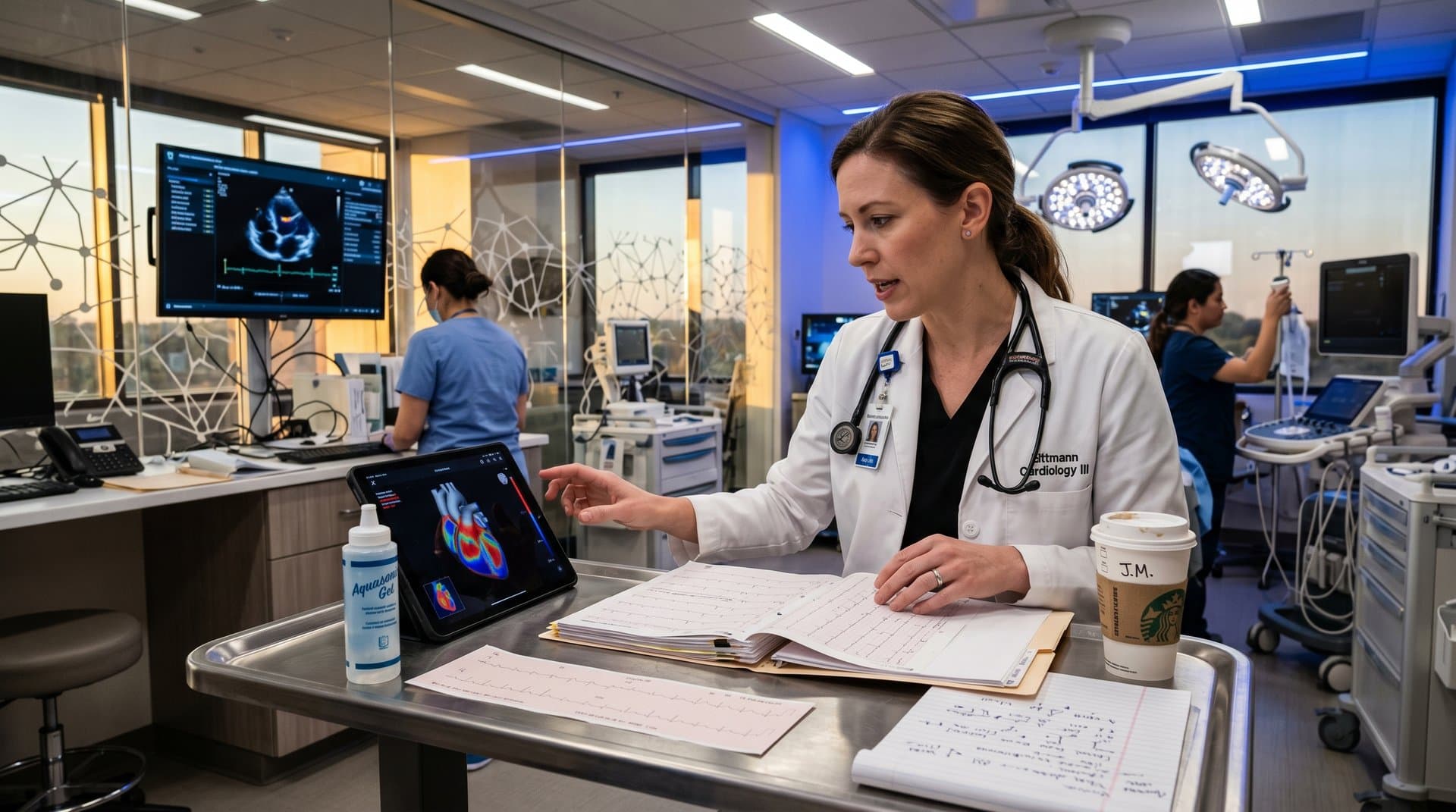
Ultromics partners with GE Healthcare. EchoGo overlays heatmaps on weakened heart muscle, guiding clinicians instantly to problem areas.
Anumana, acquired by Tempus, uses wearables for continuous alerts on emerging risks.
- Tool: EchoGo HF · Company: Ultromics · Detection Focus: Low LVEF · Key Metric: 93% sensitivity
- Tool: ECG-LVEF · Company: Anumana/Tempus · Detection Focus: Heart failure risk · Key Metric: 7.5x detection rate
- Tool: Caption AI · Company: Caption Health · Detection Focus: Echo guidance · Key Metric: FDA-cleared real-time views
Cleveland Clinic deploys these tools across 20+ sites. Goldman Sachs invests heavily, echoing fintech booms. Tempus raised $200 million in Series G funding in 2024, valuing the firm at $8.1 billion.
Patient Survival Stories from AI Cardiology
Teacher Lisa Grant, 58, dismissed chest tightness as stress. Her hospital's AI ECG detected atrial fibrillation. An ablation restored her rhythm. "I teach full-time again," Grant says from her classroom.
Truck driver Ray Morales skipped checkups. A DOT physical's portable AI uncovered cardiomyopathy. Medications stabilized him. "AI saw what I ignored," Morales shares during a follow-up scan.
These patients celebrate second chances. Doctors oversee all final decisions.
Google DeepMind forecasts ischemic events from routine MRIs. Dr. Steven E. Nissen, chair of cardiovascular medicine at Cleveland Clinic, validated the model in 2023 trials showing 85% precision.
Doctors Skeptical of AI in Cardiology
Cardiologists question "black box" opacity. A NEJM review by Dr. Eric Topol, founder of the Scripps Research Translational Institute, warns of error risks and workflow burdens.
False positives strain schedules. Liability fears loom large.
The EU AI Act classifies cardiac tools as high-risk by late 2026, demanding transparency.
Topol champions hybrids: "AI suggests; doctors decide." His trials slash diagnostic time by 20-30%. Trust builds as outcomes improve.
Finance Fuels Artificial Intelligence in Cardiology Future
Venture capital pours in despite market volatility. Health AI startups raised $1.2 billion in Q1 2024 alone, per CB Insights. BlackRock and Goldman Sachs back leaders like Tempus and Ultromics.
Apple Watch integrates ECG AI for millions of users. Blockchain platforms secure patient data across networks.
Mayo Clinic expands trials nationwide. Skepticism fades as AI handles routine scans with proven results. FDA clears more tools yearly—over 950 AI/ML devices approved to date.
Dr. Topol predicts: "By 2030, Artificial Intelligence in Cardiology will redefine the field, blending human insight with machine precision." Investors wager billions on this lifesaving tech-finance fusion.
Frequently Asked Questions
What is artificial intelligence in cardiology?
Artificial intelligence in cardiology employs machine learning to interpret ECGs, echoes, and MRIs for early disease detection. Tools like Ultromics EchoGo analyze images with 93% sensitivity. FDA oversees these as SaMD.
How does artificial intelligence in cardiology help overlooked patients?
AI flags subtle risks in routine tests missed by busy clinicians, enabling timely interventions. Anumana detects low LVEF 7.5 times more often. Rural and underserved patients gain access via portable devices.
What accuracy does AI achieve in heart failure detection?
Tools like Ultromics EchoGo reach 93% sensitivity for low ejection fraction on echoes. Anumana boosts case finding 7.5-fold via ECG. Performance varies by validation dataset.
What regulations govern AI cardiology tools?
FDA clears devices via 510(k) pathways, with over 950 AI/ML tools approved. EU AI Act labels cardiac AI high-risk, requiring conformity by 2026. Transparency audits address black-box issues.