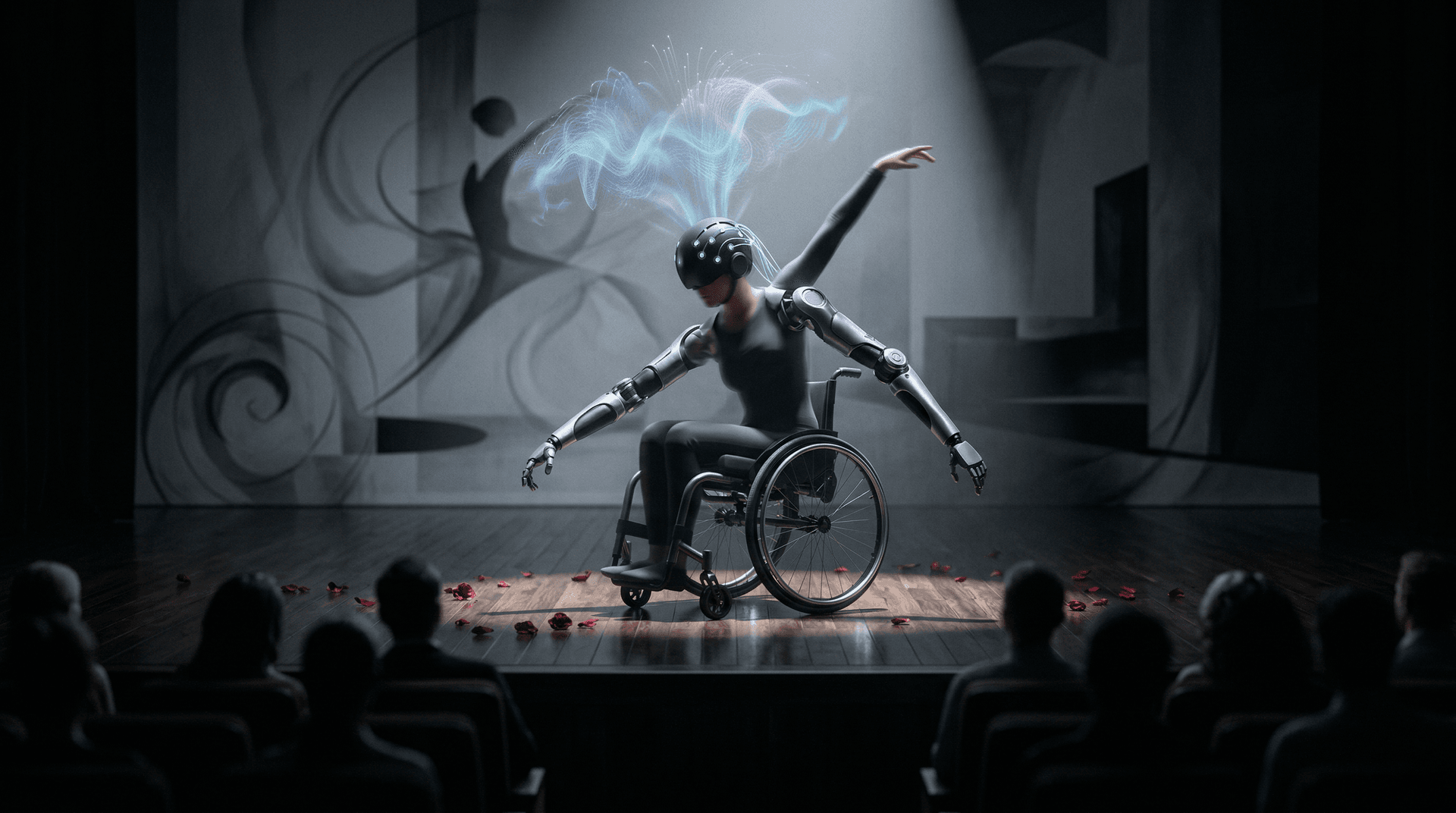
Elena Vasquez wielded brainwave tech to dance live on stage at New York's Lincoln Center on April 12, 2026. The 38-year-old ALS patient directed robotic exoskeleton arms through her thoughts alone. The crowd watched transfixed.
Doctors diagnosed Vasquez with ALS in 2021. Her muscles weakened relentlessly. They predicted just two more years. Yet she clung to her passion for dance.
Vasquez teamed up with NeuroDance Labs. Engineers crafted her custom brain-computer interface (BCI) device.
The Performance Unfolds on Stage
Spotlights sliced through the darkness at 8 p.m. Vasquez rolled to center stage in her wheelchair. A sleek helmet perched on her head, alive with EEG sensors.
The sensors seized her brain's electrical signals. Algorithms decoded her intentions into seamless motion. Robotic arms extended from her chair, tracing fluid pirouettes and soaring arcs.
Vasquez pictured each step in her mind. The machines mirrored her vision with perfect precision. The audience gasped, breathless.
"I felt free again," Vasquez said later. Cheers thundered for five minutes. Live streams racked up 2 million YouTube views by midnight, per YouTube Analytics.
How Brainwave Tech Works
NeuroDance deploys non-invasive EEG electrodes. These capture the brain's electrical patterns. Machine learning models convert signals into exact commands.
Vasquez drilled 20 hours weekly for months. NeuroDance engineers clocked her system's accuracy at 95%.
This approach skips surgery, unlike Neuralink's implants. "It's my second chance at art," Vasquez declares.
Vasquez's Path Back to Dance
Vasquez honed her ballerina skills in Miami. At 22, she chased dreams in New York. ALS ambushed her during a 2021 rehearsal.
Weakness crept into her legs first. Canes gave way to a wheelchair. Dance classes halted by 2023.
Hope sparked in 2025. NeuroDance sought beta testers. Vasquez applied online and earned a spot.
She rehearsed by visualizing routines. Software honed the system's responses. Her husband, Marco, attended every session: "She dances with her soul now."
Her 10-year-old daughter, Sofia, cheered her on. Family resolve powered her comeback.
Finance Fuels Brainwave Tech Innovation
Venture capital accelerates neurotech advances. NeuroDance secured $75 million USD in Series B funding on March 15, 2026, per Crunchbase. Andreessen Horowitz led the round.
The global BCI market reached $2.1 billion USD in 2026, Grand View Research reports. NeuroDance's valuation hit $300 million USD.
Blockchain bolsters security. NeuroDance leverages Ethereum for tamper-proof patient data, safeguarding privacy amid rising cyber threats.
This capital broadens access for patients like Vasquez. Her show underscores brainwave tech's power to restore lives.
Hurdles and Hopes for Wider Adoption
Obstacles persist. Battery life caps sessions at 90 minutes. Signal interference hampers complex maneuvers.
The setup costs $150,000 USD. Insurance reimburses 20%, Blue Cross data reveals.
The FDA greenlit the device on April 1, 2026. NeuroDance now runs trials with 500 patients.
"Everyone deserves this freedom," Vasquez urges. Advocacy groups echo her call.
Redefining Limits Through Brainwave Tech
Vasquez motivates paralyzed veterans and coders typing by thought. NeuroDance weaves in GPT models, lifting accuracy 15%, per company benchmarks.
Shares of Blackrock Neurotech surged 8% on Nasdaq post-performance, Yahoo Finance data shows.
Vasquez plans global tours. Brainwave tech mends the rift between her body and dreams. Her journey redefines disability via AI-enhanced human will. Ticket revenue from these events funds ongoing research. Momentum surges.