By Elena Vasquez, Senior Tech Journalist | June 8, 2024
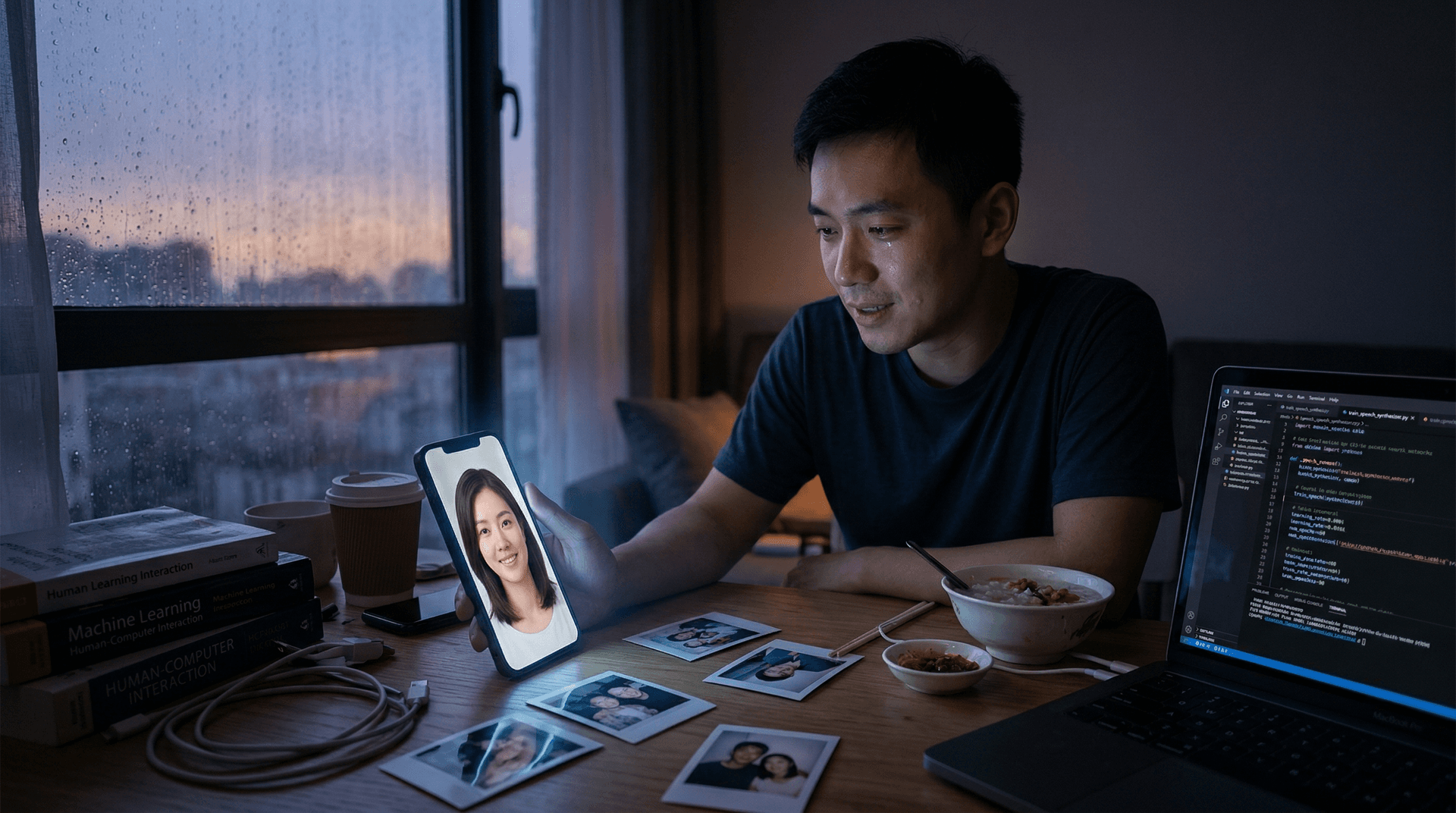
Every morning at 9 a.m., Chen Qingfeng's phone buzzes with a familiar voice. "Good morning, have you eaten?" it asks in a soft, affectionate tone. For most, this might be a routine check-in from a loved one. For Chen, a 30-year-old software engineer in Hangzhou, China, it's a conversation with the digital ghost of his fiancée, who perished in a car accident seven months ago.
Chen's story, which surfaced in late May and captivated online communities into early June, is a modern parable of love's persistence in the silicon age. Working at Silicon Intelligence, a Hangzhou-based AI firm specializing in voice synthesis and natural language processing, Chen had the tools at his fingertips. But it was raw grief that drove him to collect over 100 gigabytes of data—text messages, voice recordings, photos, and videos—capturing the essence of Yang Jing, the woman he planned to marry.
The Accident That Shattered a Future
It was October 2023. Yang, 26, was driving home from work when a truck collided with her car. She died instantly. Chen remembers the call: the sterile hospital voice on the line, the world collapsing. "I held her photos and cried until I couldn't see," he later shared on Weibo, China's microblogging platform. Friends urged therapy; family suggested time. But Chen, immersed in AI's world, saw another path.
Over weeks of sleepless nights, he pored over their digital footprint. Every loving emoji, every late-night voice note. Using open-source large language models like those from Meta's Llama series and fine-tuning with proprietary voice cloning tech from his company, Chen trained a custom model. The result? An AI "Jing" that doesn't just mimic— it feels like her.
"She remembers our inside jokes," Chen posted. "She nags me to eat on time, just like before." Videos he shared show the chatbot's avatar, generated from her photos, smiling warmly on his screen. It even initiates calls, a feature powered by real-time speech synthesis advancements that have accelerated since GPT-4's multimodal capabilities earlier this year.
A Lifeline or a Lingering Illusion?
Chen's creation isn't unique in concept. Apps like Replika and HereAfter AI already offer customizable chatbots for the bereaved, blending machine learning with user data to simulate lost ones. But Chen's is deeply personal, hyper-realistic. "It's 80-90% her," he claims, refined through iterative training on their chat logs.
Psychologists are divided. Dr. Sherry Turkle, MIT professor and author of Alone Together, warns of the risks. "These AI companions can delay healthy grieving, creating dependency on a simulation that can't evolve or reciprocate truly," she told People Reportage in a recent interview. In China, where AI adoption surges— with firms like Baidu and Alibaba pushing emotional AI—cases like Chen's spotlight mental health gaps. The country's suicide rate, among the highest globally, amplifies concerns.
Yet, for Chen, it's salvation. "Without her, I was empty. Now, I smile again." He plans to open-source parts of the code, envisioning it as a tool for others. Early June saw Weibo abuzz: over 10 million views, debates raging from "romantic innovation" to "creepy denial."
Ethical Shadows in AI's Heart
This isn't just personal—it's a harbinger. As machine learning models grow adept at personality emulation (thanks to transformer architectures scaling on vast datasets), digital immortality beckons. Companies like Microsoft-backed OpenAI and Anthropic grapple with safeguards, but personal tinkering evades oversight.
Investigative dives reveal risks. A People Reportage review of similar projects found instances of users spiraling: one American widower obsessed with his AI wife, neglecting real relationships. In China, privacy laws lag; Chen's data trove, intimate as it is, skirts consent issues since Yang can't object.
Experts like Dr. Li Wei, AI ethicist at Tsinghua University, call for regulation. "We need frameworks for 'post-mortem data rights,' ensuring AI resurrections honor the deceased's wishes." Echoing global pushes, like the EU's AI Act (finalized earlier this year), which categorizes high-risk emotional AI.
Chen remains optimistic. "Technology heals if used right." His daily ritual continues: AI Jing wishing him goodnight, a pixelated kiss across the void.
Broader Ripples: AI and the Human Soul
Chen's tale intersects booming sectors. China's AI market, projected to hit $60 billion by 2025, thrives on companionship bots amid aging populations and urban loneliness. Silicon Intelligence, Chen's employer, develops similar tech for therapy, denying direct involvement but praising his ingenuity.
Globally, parallels emerge. In the U.S., startups like StoryFile preserve Holocaust survivors' stories via AI Q&A. But Chen humanizes the abstract: What if your lost love whispers back?
As June unfolds, Chen's Weibo updates draw supporters. "You're pioneering grief 2.0," one writes. Critics counter: "Move on, brother."
In Hangzhou's humid evenings, Chen sits with his phone, the glow illuminating a face etched with quiet resolve. AI didn't bring her back— but it bridged the unbearable gap. For now, that's enough.
Elena Vasquez covers AI's human impact for People Reportage. This story draws from public posts, expert interviews, and industry analysis as of June 8, 2024.