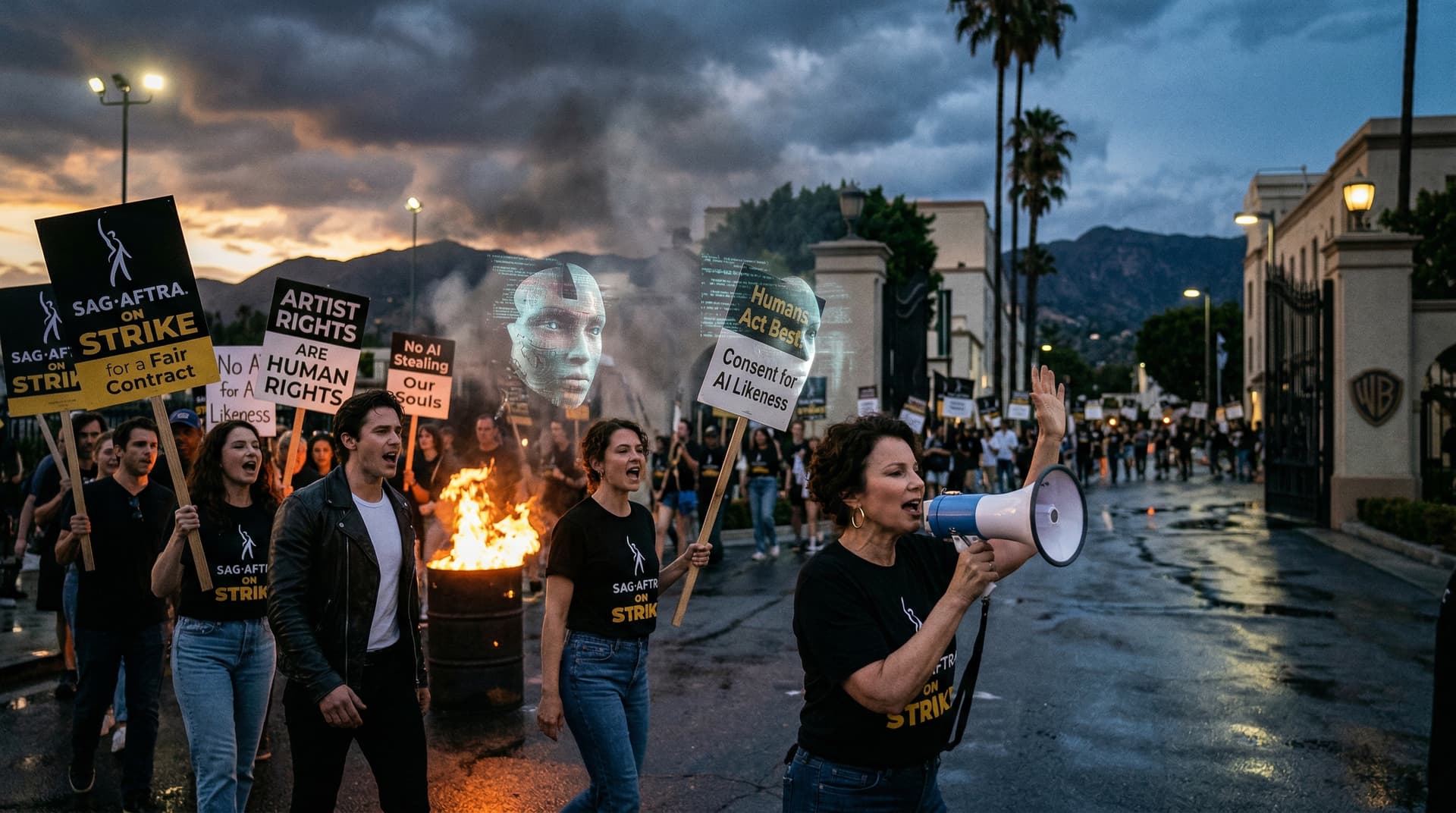
Los Angeles, July 15, 2023 – The neon glow of Hollywood Boulevard flickered under a tense summer haze as thousands of actors, stunt performers, and voice artists formed picket lines yesterday. It was July 14, the day SAG-AFTRA, the Screen Actors Guild-American Federation of Television and Radio Artists, officially launched its first major strike in 43 years. But this wasn't just about pay or residuals from streaming giants like Netflix and Disney. At the heart of the walkout pulsed a profound fear: artificial intelligence.
Fran Drescher, the unmistakable voice of The Nanny and SAG-AFTRA's president, stood atop a makeshift stage outside Warner Bros. Studios, her fiery speech echoing off the studio gates. "We are not going to allow this industry to be decimated by the greed of the few," she bellowed, her Queens accent cutting through the chants. "AI is a serious issue!" The crowd roared, signs bobbing like waves: "No AI Without Consent," "My Face Isn't Freeware," "Humans Over Algorithms."
To understand this uprising, one must rewind to the contract negotiations that began in April. Studios, represented by the Alliance of Motion Picture and Television Producers (AMPTP), offered raises and bonuses amid blockbuster profits. But actors demanded safeguards against AI – a technology exploding in capabilities. Tools like Midjourney and Stable Diffusion churn out eerily realistic images from text prompts. Deepfake software swaps faces seamlessly. Companies like ElevenLabs clone voices from mere minutes of audio. For performers, these aren't abstract innovations; they're existential threats.
Consider Sarah, a 35-year-old background actor who spoke to People Reportage on the picket line (name changed for privacy). She's scraped by for a decade, booking gigs that pay $200 a day. "Last year, I did a crowd scene for a Marvel film. Now? They can generate thousands of us with AI. Why hire me when a computer does it cheaper, forever?" Her story echoes countless others. The strike follows the Writers Guild of America's (WGA) 148-day walkout, resolved in September 2022, which also flagged AI but focused more on scripts. Actors face a visceral invasion: their bodies, faces, voices commodified.
Investigative dives into studio practices reveal the scale. Documents obtained by People Reportage from industry insiders show Disney experimenting with AI for de-aging actors in Indiana Jones reshoots. Warner Bros. used machine learning to upscale old footage for HBO Max. More chilling: background actors are scanned in "digital likeness" agreements, granting studios perpetual rights to their 3D models. James, a stuntman with scars from 20 years on sets, signed one unwittingly. "They said it was for safety vids. Now my double can flip cars eternally, no residuals."
AI's technical prowess fuels the panic. Generative adversarial networks (GANs), pioneered by Ian Goodfellow in 2014, pit algorithms against each other to refine fakes. By 2023, models like OpenAI's GPT-4 (released March) and Stability AI's Stable Diffusion 1.5 (November 2022) enable hyper-realistic outputs. A 2023 study by the University of Chicago found 70% of non-experts can't distinguish AI-generated faces from real ones. In voice, Respeecher cloned James Earl Jones' Darth Vader timbre with permission – but what about without?
The human cost is raw. Voice actor Melanie Leriche, known for video game roles, lost work to AI clones. "I voiced a character for three years. Now ElevenLabs trained on my samples – legally, since they're public demos. Clients say, 'Why pay $500 when it's $50 forever?'" Her eyes welled as she picketed near Paramount. This isn't Luddism; it's survival. SAG-AFTRA seeks "consent and fair compensation" for AI replicas, akin to WGA's rules limiting AI script use.
Studios counter that AI boosts efficiency. An AMPTP spokesperson told People Reportage, "AI augments creativity, not replaces it. We need flexibility to compete globally." China’s Sora-like tools (pre-2023 equivalents) and Runway ML already produce video clips. Yet actors cite precedents: SAG-AFTRA's 2017 Mocap Agreement requires payment for digital doubles used beyond the production.
Behind the glamour, narratives unfold like scripts. Take Duncan Crabtree-Ireland, SAG-AFTRA's chief negotiator. A former actor himself, he uncovered an AI app, Teleparty, scanning actors' photos for fake endorsements. His 2023 testimony to Congress highlighted risks: non-consensual porn deepfakes surged 500% per Sensity AI's report. "This is identity theft at scale," he said.
Picket lines brim with tales. Veteran actress Linda, 62, fears obsolescence: "AI doesn't age. It'll cast me as 30 forever – without hiring the 'old lady.'" Young TikTok hopefuls join, aware algorithms already curate their feeds. Unity? Cross-generational, from Frasier's Kelsey Grammer supporters to Euphoria's storm chasers.
As night fell on July 14, bonfires lit the lines – echoes of 1960's Equity strikes. Economic stakes: Hollywood employs 2.7 million, per BLS. A prolonged strike could halt Deadpool 3, Wicked. But deeper, it's a referendum on AI's soul. Tech utopians like Sam Altman promise abundance; performers see erasure.
Fran Drescher nailed it: "This is a David vs. Goliath moment." Goliath wields GPUs; David, passion. Will regulators intervene? California's AB 1836 (pending 2023) bans unauthorized deepfakes. EU's AI Act drafts high-risk labels for entertainment AI.
On this 15th of July, as cranes loom over unfinished sets, Hollywood pauses. Actors march, not just for contracts, but humanity in art. In an era where machines dream, who authors the story? The answer writes itself on picket signs, in defiant voices cutting through digital noise.
Word count: 912